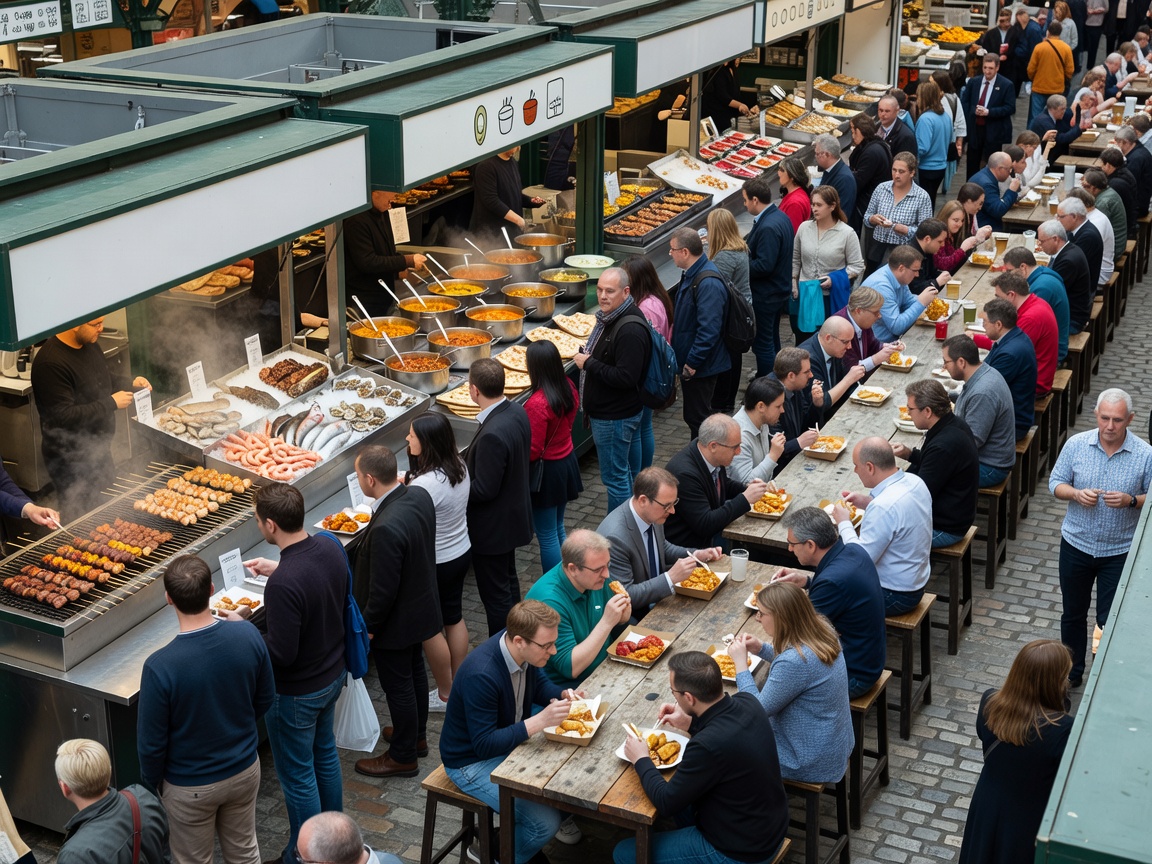
Why market lunches suit London
London’s scale helps the market format. People move through the city in streams, lunch hours are uneven, and tastes differ wildly within a single group. A market absorbs that variety better than most restaurants can. One person gets a grilled sandwich, another a curry, another a pastry and coffee, and the meeting still happens. The structure is forgiving. It also allows specialists to thrive by doing one dish or one cuisine with unusual focus.
The downside is obvious too. Markets can be louder, less sheltered and less predictable than restaurants. Seating is often partial rather than guaranteed. Queue patterns may change faster than your patience. A market lunch is usually a better answer for appetite and variety than for serenity.
Borough Market: range, theatre and strategic walking
Borough Market is the most obvious name in the category, and for once the obvious answer is not wrong. Its strength is density. You can move from cheese to grilled meat to fresh pasta to pastries in a matter of minutes, and the quality ceiling remains high because the market contains both produce traders and prepared-food specialists. It also benefits from the simple pleasure of place: railway structure overhead, old market geometry, constant motion.
At lunch, though, Borough works best if you accept its terms. It is not a hidden find. It is a destination, often busy, and sometimes better approached with a rough target in mind rather than a fully open brief. The more indecisive the group, the more time disappears. Borough rewards appetite, curiosity and a tolerance for crowds. It is less kind to anyone wanting a quick seated meal with low sensory noise.
Maltby Street Market: compact and characterful
Maltby Street Market offers a different pleasure. It is more contained, often feeling like a stitched-together corridor of strong options rather than an urban institution spread across multiple edges. That compactness can be a virtue at lunch. Decisions come faster. The mood is less dispersed. There is still variety, but not so much that choosing becomes a project.
Because it sits with a stronger sense of enclosure and discovery, Maltby Street can feel more personal than Borough, though that should not be confused with calm. Popular traders still attract queues, and a narrow market lane can bunch quickly. Still, for people who want the energy of a London market lunch without the broader sprawl, Maltby Street often lands more cleanly.
Leather Lane: weekday usefulness over destination romance
Leather Lane in Clerkenwell has a different social role. It is less about the idea of the market as an attraction and more about the market as lunch infrastructure. That changes the atmosphere in useful ways. There is purpose to the trade. People know why they are there. Lunch can be fast, flavourful and pragmatic without feeling joyless. The surrounding office population gives the area a reliable weekday pulse.
This kind of market may be the best answer when the question is not where shall we spend lunch, but where can we eat well and get on with the day. Leather Lane shines in that register. It is not trying to become a full excursion. It is simply very good at feeding people at noon.
Choosing by temperament, not by fame
If you want breadth and the charge of a famous London food setting, Borough Market is the natural choice. If you want a smaller field with a stronger sense of route and discovery, Maltby Street Market makes more sense. If your lunch hour is really a workday tool and flavour must coexist with efficiency, Leather Lane is hard to dismiss.
It also helps to think about company. Market lunches are excellent for groups with mixed tastes and low need for formality. They are less ideal for anyone who wants the meal to proceed in a single shared rhythm. A restaurant gathers everyone into one pace. A market fragments the experience a little, then reunites it at the eating stage.
What markets do better than restaurants
Markets often beat restaurants on immediacy, range and the ability to satisfy a very particular craving. They are also good for repeat visits because you do not need to commit to the same stall each time. Restaurants, by contrast, do better at control: acoustics, seating, weather protection and continuity of service. The best London lunch habits usually include both. Some days call for a table and a waiter. Some days call for a paper tray and an efficient walk.
That is why market lunches remain central to London’s midday life. They fit the city’s restlessness. They make room for specialist traders. And when chosen with a little care, they turn the practical act of lunch into something much brighter.